

Where historical scholarship meets artistic liberties
The author's note for Octavia Hall

I’ve been working on the back matter for my book, and enjoying it more than I expected, so I thought I’d share the note that will appear just before the acknowledgements. (Because that’s where Google said to put it.)
Don’t worry, there are no spoilers!
Author’s note
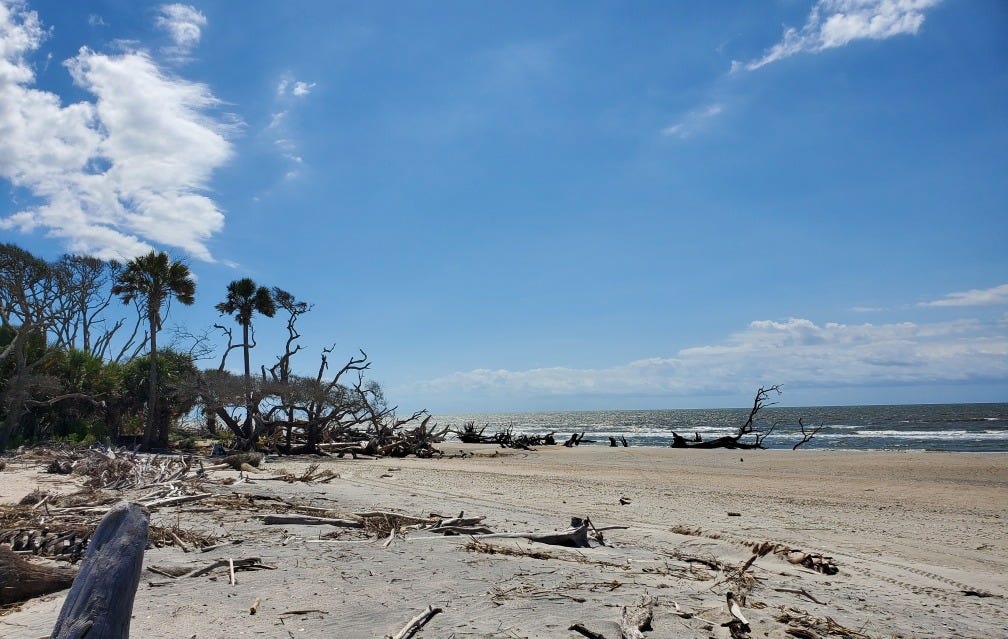
Growing up in South Carolina, I enjoyed frequent visits to the barrier islands and beaches around Charleston. These included Edisto, Seabrook, Folly Beach, Johns Island, Kiawah, James Island, Fripp, and of course Charleston itself. Researching this book, and learning more about the history of these places, was an illuminating experience I will always treasure.
Octavia Hall is a work of fiction. Any errors that directly contradict historical scholarship are my own. That said, for the sake of storytelling I did take some artistic liberties. Charleston, for example, was still called Charles Town in 1780. The current spelling wasn’t adopted until 1783; I hope that choice wasn’t too distracting. Cinder Island is a fictional amalgam of various barrier islands, though I think the description of the setting evokes the spirit of the real places. The towns depicted are also fictional. The coastal lands in 1780 were largely made up of vast farms and plantations, but trading posts and towns (like Beaufort and Moncks Corner) did multiply and expand with the population growth that the colony saw in the 1700s. Rice and indigo were the most profitable crops in South Carolina during the war years, grown and processed via slave labor.
I would also like to note three areas that may seem exaggerated in the story, but were in fact quite rooted in truth:
The impact of colonial diseases on the British troops: Malaria, dysentery, and yellow fever ran rampant through South Carolina in 1780 and decimated their numbers. Neither officers nor men of rank were spared. The marshes and swamps of the Lowcountry were breeding grounds for disease-carrying mosquitos, and since the local colonists had grown up in such conditions, those who survived to adulthood had a definite advantage. An apothecary’s daughter like Hannah would have witnessed such disease from an early age, and learned every possible course of treatment to provide relief. British soldiers sent to the West Indies fared the worst, and many considered a posting to those colonies akin to a death sentence.
Desertion and changing sides: It is important here to remember that the American Revolution was essentially a civil war. As a result, there were times when it seemed like there was a revolving door between camps. Soldiers changed sides for all sorts of reasons: low morale, family ties or lack thereof, dissatisfaction with pay, or feuds with other soldiers. Some men simply vanished--the “missing” count after a number of battles is suspiciously high--and presumably attempted to start a new life elsewhere, unencumbered by a commitment to either army. Parliament’s Press Act (officially called the Recruiting Act, though I saw both names used while researching) did coerce many British men to serve in America who might have refused in other circumstances. There are even reports of British inmates maiming themselves to avoid being sent to fight; a precursor to the sometimes self-inflicted Blighty wound of the trenches during WW1. The health of these recruits was often considerably worse than that of the career soldiers who came to America in the earliest years of the war. A young man like Silas, able-bodied and with outstanding debts, would have been ripe for the plucking under the Press Act.
Loyalists: Men and women like William, who believed they were the true patriots due to their loyalty to the King, played a huge role in the Southern Campaign. In Mark Urban’s wonderful book Fusiliers: The Saga of a British Redcoat Regiment in the American Revolution there is an entire chapter devoted to the discussions in Whitehall and Parliament about the future of the war, and where the British Army might have the most success in regaining momentum. They settled on South Carolina because of the multiple testimonies from expatriated colonists who assured them that, in spite of the firebrands in Charleston, most people in South Carolina were loyal to the Crown. Of course, that turned out not to be the case, as we shall explore further in the next volume of this series when we venture into the Backcountry...
Haven’t read the first book yet? Find The Turncoat in Carrington Park on Amazon.